Publications and media
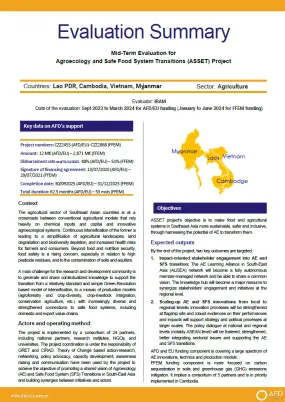
Mid-Term Evaluation for Agroecology and Safe Food System Transitions (ASSET) Project
ASSET project’s objective is to make food and agricultural systems in Southeast Asia more sustainable, safer and inclusive, through harnessing the potential of Agroecology to transform them. At the...
Published on
Inequality Matters: Can the GNU solve inequality in South Africa?
South Africa remains the most unequal society in the world, with persistent disparities rooted in the legacies of colonialism and apartheid. Despite three decades of democracy and redistributive polic...
Comparative analysis of biodiversity measurement approaches for public development banks
Biodiversity loss is a major global challenge, pushing public development banks (PDBs) to align with frameworks such as the GBF, TNFD, and CSRD. To support this, AFD and EBRD assessed six biodiversity...
Just Energy Transition, Structural Inequities, and Social Mobility: The Case of Mexico
Mexico’s energy transition unfolds in a context of deep structural inequalities and persistently low social mobility. While most households have electricity, large disparities remain in affordability,...
Institutional Implementation of In-Kind Subsidies for Distributed Generation: Multi-Level Governance and Poli...
This article develops an institutional implementation model for a public policy aimed at replacing traditional residential electricity subsidies with in-kind schemes through the delivery of solar phot...
Redesigning Electricity Subsidies for Distributed Generation in Mexico: A Fair Transition Model Applied to Nue...
Mexico is faced with a dual energy challenge: to move forward in a transition towards clean sources while meeting the immediate nearshoring demands, calling for a reliable electricity infrastructure....
Analysis of the Social Impacts and Vulnerabilities Linked to the Just Dimension of an Energy Transition in Mex...
Mexico’s just energy transition (JET) requires addressing both decarbonization and deep social inequalities. This study analyzes four high-impact measures: the retirement of fossil-fuel plants, the ex...
Ameliorating the Consequences of Coal Job Destruction - A Just Transition Policy Matrix Approach
Ensuring a just energy transition in South Africa requires supporting workers to absorb the negative shocks of structural change. Central to this is the design of a comprehensive social protection pac...
The sustainable valuation of the Congo Basin forests: A real possibility?
Spanning some 268 million hectares across Cameroon, Gabon, the Republic of the Congo, the Democratic Republic of Congo (DRC), the Central African Republic, and Equatorial Guinea, the forests of the Co...
Reducing Inequalities: Insights from the EU-AFD Research Facility
In this summary, find more information about the lessons learned, tools, and partnerships developed within the framework of the EU-AFD Facility for Research on Inequalities between 2020 and 2025.
Published on
Beyond Redistribution: Market Power, Firm Structure, and the South African Labour Market
This paper examines how firm structure and market power shape inequality in South Africa. Moving beyond a narrow focus on fiscal redistribution, it introduces a pre-distribution lens that highlights t...
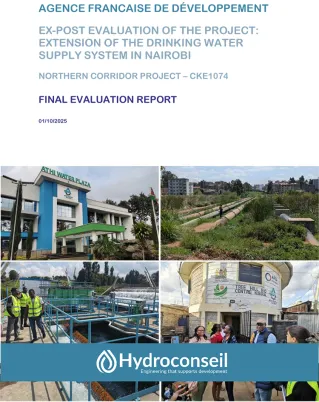
Ex-post evaluation of the project Extension of the drinking water supply system in Nairobi (CKE1074)
The project, financed by AFD and implemented by Athi Water Works Development Agency (AWWDA), is part of a wider project to improve Nairobi's drinking water supply, in line with the city's drinking wat...
Published on
Data Analytics for a Just Transition. Distributional Impacts of Environmental Policies (Indonesia)
Indonesia’s commitment to the Paris Agreement has placed carbon pricing through taxes and emissions trading at the center of its climate policy. These instruments are designed to reduce greenhouse gas...
Skills ecosystem mapping of MSMEs located within the Nkangala District Municipality
This paper examines the skills ecosystem for Micro, Small and Medium Enterprises (MSMEs) in Nkangala District Municipality (NDM), Mpumalanga—a coal-dependent region central to South Africa’s Just Ener...
The Impact of the Green Transition on Jobs in South Africa
One of the key issues in policy discussions over addressing climate concerns the ways in which countries need to and can balance the combating of climate change with job creation and economic developm...
Addressing the persistence of female genital mutilation: Current situation and prospects for effective interve...
With Unicef estimating that 230 million women and girls have undergone female genital mutilation (FGM) globally, the international human rights agenda sets the goal of eliminating the practice. Yet, d...
How can the intersection of gender and commons perspectives establish a new framework for action for developme...
In recent decades, significant progress has been made in connecting gender and commons issues, both in academic approaches and in concrete initiatives. Gaining a better understanding of this literatur...
When Information Feeds Social Transformation in Indonesia: Understanding and Addressing Inequality outside Jav...
Although Indonesia ha recorded progress in reducing national income inequality over the past decade—evident in the decline of the Gini coefficient from 0.409 in 2012 to 0.384 in 2021—substantial dispa...
Sargassum beachings challenges in the Western Atlantic A scoping review
Over the past decade, recurrent Sargassum beaching events have become a significant ecological and socio-economic concern across the tropical Western Atlantic Ocean, particularly affecting Caribbean a...

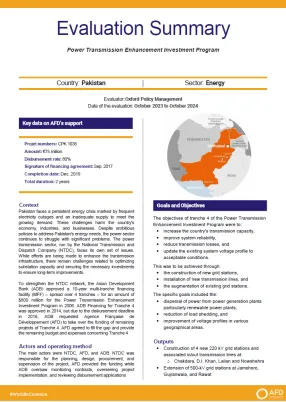
Evaluation of Power Transmission Enhancement Investment Program, Pakistan (CPK1036)
The objectives of tranche 4 of the Power Transmission Enhancement Investment Program were to: • increase the country's transmission capacity; • improve system reliability; • reduce transmission los...
Published on
Armenia:Democratic impulse,economic growth and the challenges of transformation for an economy under pressure
The strong economic growth supported by the influx of Russian migrants in 2022 and 2023 (12.6% and 8.3%, respectively), combined with improvements in the macro-fiscal framework driven by the ongoing S...